The Wonderful World of Kindergarten

Welcome to our Reggio Emilia inspired classroom at Dr. David Suzuki School.
JoAnne Pizzuto, OCT & Jocelyne Brent, RECE, BASc (Hons)
Showing posts with label counting. Show all posts

Thursday, 13 November 2014

Pumpkin Math

While our light table was being prepared by many friends who took turns writing numbers 1 to 100.
They made a 100 Grid chart right on the light table!
Danica's printing was so neat and she knew all the numbers without any help. She was very satisfied with her efforts!
Children were busy cutting, scooping and
s e p a r a t i n g   the seeds from pumpkins.

Each child filled their own bowl with the seeds from the pumpkin they had cut open and scooped out.
This was gooey, slimy, slippery work!

Some pumpkins were small, some were flat and red, some had funny bumps and some were huge!
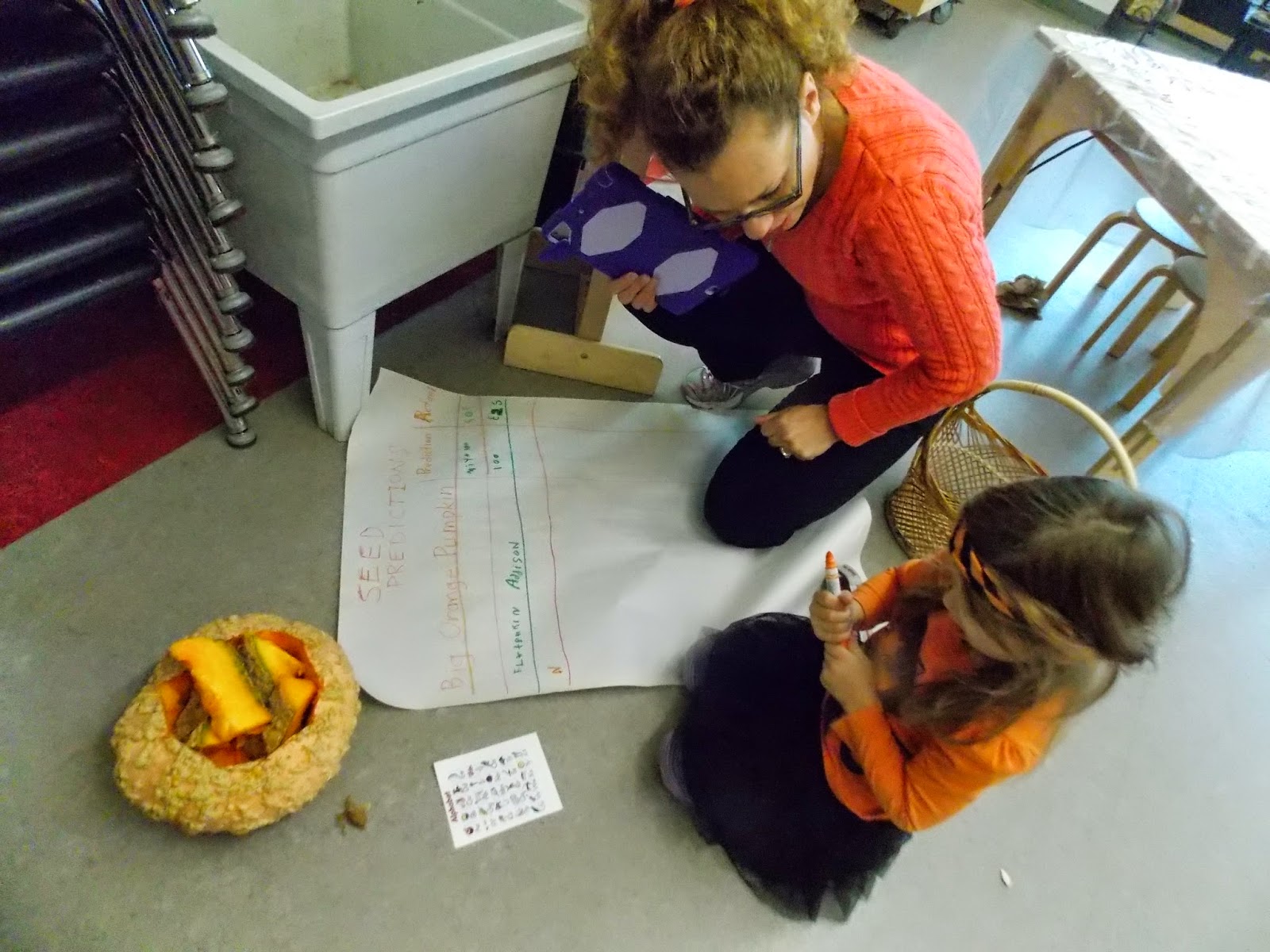
Once the children had scooped all the seeds they could into their bowls, they made a prediction.
How many seeds were in their pumpkin?
They came one by one to fill in a chart.
The chart had a title, 'Seed Predictions'.
The chart had 3 columns, 'Description', 'Prediction' and 'Actual'.
Miya's pumpkin was 'Big Orange Pumpkin'. She predicted 100 seeds.
Addison's pumpkin was 'FLAt PAKiN'. She also predicted 100 seeds
 Sienna was especially excited to count her pumpkin seeds. She had carved the 'ROF TOP PMPKn' and predicted 16 seeds!
Sienna counted her seeds by putting one seed in each square. She filled all 100 squares and still had 8 more. What was Sienna's actual amount?
Before he predicted and counted his own 'RAD FLaT POMPGIN'
(which he predicted to be 31 seeds),
 Isaac helped Ryan and Jun count the seeds they had scooped.
Their pumpkin was a giant one! They described it as 'JANT PKIN'
and predicted 600 seeds.
  They looked at Miya's number in the 'Actual' column first.
They were sure it had more than Miya's!
Miya had put 10 seeds in each square. She filled 5 lines of 10 squares in the 100 Grid with seeds and still had 7 leftover.
Well, the boys also put 10 seeds in each square.
They really had to practice to count by 10's.
They also filled 5 full lines but had 10 leftover.
Can you determine which pumpkin had more seeds?
Abigail decided her pumpkin looked nutty because it had light tan coloured bumps all over it. She called it 'NUTE PMPKN' and predicted 20 seeds.
She put one seed in each square and also filled all 100 squares.
She counted 19 left over.
How many seeds in all?


The actual amount of seeds were:
Big Orange Pumpkin, Miya - 507
FLAt PAKiN, Addison - 325
NUTE PMPKN, Abigail - 119
JANT PKIN, Jun & Ryan - 510
RAD FLaT POMPGIN, Isaac - 156
ROF TOP PKN, Sienna - 108
 
You can imagine the fun discussions we had as we gathered together and the children talked about their pumpkins and how many seeds they had predicted and counted!
We can imagine the fun discussions you will have talking about our pumpkin math!
 
Now the pumpkins are in the 'Decomposition Centre' under the windows in the front of the school near our side door. Check them out when you come by.
What's happening to them?
 
We are waiting for Riverside Library to call and tell us when
is ready for us to pick up!


Monday, 20 October 2014

Creating Our Number Wall

Each year the children create a new number wall. This wall has the numbers 1 - 10 with a corresponding number of natural materials

The first fun part is making the salt dough that will be used to form the numbers.
Add the salt, add the flour, add the water...mix!


Some children formed the numbers that they knew...
Some children decided to use the number cards to get the numbers just the right size and shape.


Once the numbers were finished, they were placed on a cookie sheet and set into the oven.
And...while they were hardening, the children went on a Numbers in Nature walk.
3 fuzzy, soft, seeded dandelions
5 golden, yellow dandelion flowers
Nicely sized big leaves...1...2...3...4...
2 purple clover flowers
3 maple leaves showcasing their Autumn outfits
A branch filled with dried seed heads...more than 10!

4 red berry bush leaves and 4 red berries...8 in all

Sunday, 1 December 2013

Following The Path to Math

At school, the path to math begins as the children walk through the doors each morning and they follow it all day long.  Everywhere they go, there are patterns to be made, sorting to be done, structures to be built, ingredients to measure, designs to be created.  We can always count on the children to lead us on the path to math!  They can count on us to give them everything they need for a successful trip.


The children follow the path to math everywhere!  Here is a way for your children to continue to follow their path to math at home.

Home Foundations for Numeracy

The key to building a numeracy foundation at home is to make math and numbers part of the everyday routine of play, meals, and other household activities.

Make math a part of your everyday chores-the idea is to develop mathematical ideas through language. As you or your child tidy up, count the items. Use the toys in the toy box in a number of ways, perhaps asking, “How many pieces of puzzle are you holding? How do you know? Can you show me how?

Use language to develop children’s mathematical concepts about counting and comparing. Examples: how many, more or less, greater or smaller, longer or shorter, higher or lower, and heavier or lighter.
Make use of nursery rhymes and poems. Many of these use numbers as in “One, two buckle my shoe” or “Five little ducks went swimming one day.”

You can also encourage understanding of direction and position. Work such phrases as these into your conversation; in front or behind, up and down, top or bottom, next to or beside, before or after, inside or outside, over, under, and below.

Bath Time; For many children bath time is the highlight of their day, a chance to have the undivided attention of an adult and also play around with soap and water. A few plastic cups of different sizes will create opportunities to explore measurement.

Meal Time; Ask questions like “How many spoons are on the table?” Ask for help setting the table. “There are four of us eating. Can you find a fork for each of us?” Reverse the question to encourage the child to think, ‘How many of us will eat tonight? How many glasses should I put out?”

The great outdoors provide so many opportunities for math. Just taking a walk with your child will provide you with opportunities to use math language and it will be fun and interesting for them.